
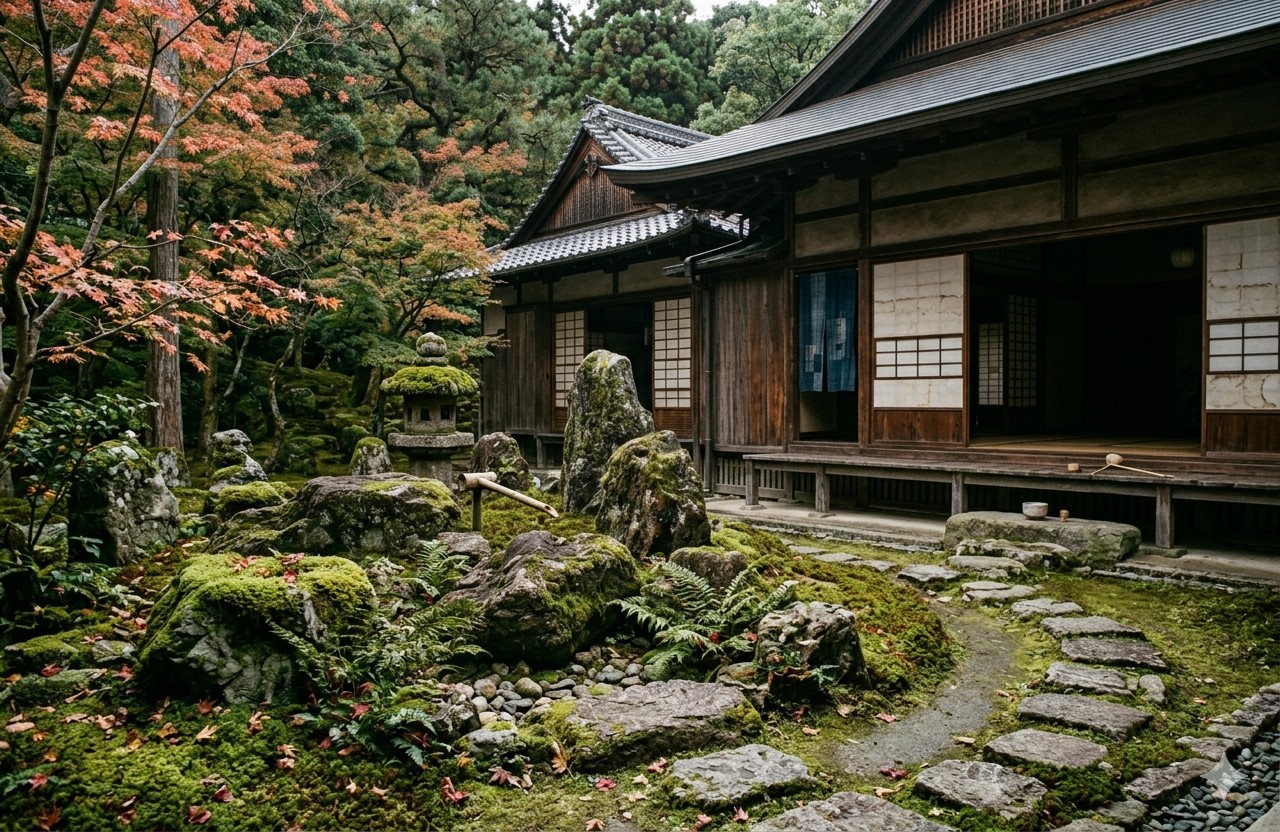
Wabi-Sabi: A Way of Seeing, Not Defining
There is a crack running along the rim of an old tea bowl in Japan. It has been there for centuries. And yet, far from being a flaw, it is precisely what makes that bowl treasured — a quiet reminder that beauty and time are inseparable.
This is often how wabi-sabi is explained. But in reality, it’s one of those words that is surprisingly difficult to define — even if you grow up in Japan.
It’s something your mind and body seem to understand without needing to put it into words.
Contents
A Familiar Word, Revisited
I moved to Australia about 20 years ago. Of course, I knew the word “wabi-sabi,” but I had never really stopped to think about what it meant. It wasn’t something we sat down and defined — it was simply there, in the background.
Interestingly, I began hearing it more often after moving overseas. It often comes up as one of those “beautiful Japanese words,” on Pinterest especially in design and lifestyle contexts.
But it was only after I started working more closely with Japanese ceramics that I began to look at it more carefully — and to question what it actually meant.
What Wabi-Sabi Really Refers To
Wabi-sabi did not begin as a clearly defined concept. It developed gradually over time, influenced by poetry, Zen Buddhism, and everyday life in Japan. Its aesthetic became more visible through the tea culture of the 15th and 16th centuries, when tea practitioners moved away from ornate imported wares and towards simpler, locally made objects.
The words themselves also changed over time.
Wabi once carried a sense of loneliness or life away from society, while sabi referred to ageing and the passing of time. Over centuries, these meanings softened, coming to express a quiet appreciation for simplicity, and a sensitivity to how things change.
Outside of Japan, wabi-sabi is often introduced as a visual style — something minimal, rustic, or imperfect. That’s not wrong, but it is only part of it.
In Japan, it is less something you define, and more something you notice. It appears in small, everyday moments — in objects, in seasons, in how things quietly change over time.
Seeing It in Everyday Life
Once you start paying attention, it is everywhere.
A ceramic bowl that sits slightly uneven on the table.
A glaze that breaks differently on each piece.
A wooden surface that deepens in tone with use.
The way light softens in the late afternoon.
None of these are designed to be “imperfect.” They simply are what they are — and over time, you begin to appreciate them as they are.
This way of seeing is at the heart of wabi-sabi.
Bringing It Into Your Home
Wabi-sabi is less a style than a way of relating to the things around you.
It might mean choosing handmade objects, not because they are “perfectly imperfect,” but because they carry a quiet individuality. It might mean keeping a piece that has changed over time, and noticing how it continues to change.
At Senju Living, this is what draws me to the makers we work with. The small variations in each piece — a glaze that settles differently, a form that isn’t completely uniform — are not something to correct. They are part of what makes each piece feel alive.
Wabi-sabi doesn’t ask for attention. It’s something you begin to notice, slowly.
In a simple bowl of tea.
In a well-used surface.
In the passing of time.
It’s simply there, in everyday moments, when you take the time to notice.
